One Face

wolfinsheepsclothingThen I saw standing in the middle of the throne and of the four living creatures, and in the middle of the elders, a Lamb that appeared to have been killed. He had seven horns and seven eyes, which are the seven spirits of God sent out into all the earth.
 
Then another sign appeared in heaven: a huge red dragon that had seven heads and ten horns, and on its heads were seven diadem crowns.
 
Then I saw a beast coming up out of the sea. It had ten horns and seven heads, and on its horns were ten diadem crowns, and on its heads a blasphemous name.
 
–Revelation 5:6; 12:3; 13:1
I continue to study through the rather difficult book of Revelation, chasing after that promised blessing (Rev 1:3) and trying to avoid the temptation to figure it all out (Act 1:7). But as I pondered such strange imagery, I found profound truth in the fact the Beast (Rev 13:1) and the Dragon (Rev 12:3) have many heads. Our enemy has many faces to masquerade his true identity (2Co 11:14), and he will deceive us (Rev 12:9) with a myriad of forms (1Co 10:20), distracting us from the one thing on which we are to stay focused (Luk 10:42). For there are many idolatrous spirits to rule our hearts, many temptations to feed our flesh, and many lies to lay claim over our minds and distort our vision.
Yet even though Christ bears many names (ex: Rev 5:5-6), and his appearance can be complex and mysterious at times (ex: like a slain lamb with seven eyes and seven horns), He has only one face to seek (Rev 22:4). We have only one Spirit to fill our hearts (Eph 5:18) and to follow (Rom 8:14). So do not waste a day distracted by the many faces of our enemy, winding up in useless toil (Ecc 1:14)—but seek His glorious face (Psa 105:4) and perform the duty (Ecc 12:13) of your calling (Eph 4:4).
“But above all pursue his kingdom and righteousness, and all these things will be given to you as well.” 
–Matthew 6:33
Billy Neal
Share Button

Golden Rule

goldenrule

If you then, being evil, know how to give good gifts to your children, how much more will your Father who is in heaven give good things to those who ask Him! Therefore, whatever you want men to do to you, do also to them, for this is the Law and the Prophets. — Matthew 7:11-12. NKJV

Men, Jesus moves into the “Golden Rule” saying “whatever you want men to do to you, do also to them…” But this is coupled into the finish of “ask, seek, and knock”. Jesus tells us, “if we being evil, know how to give good gifts to our children, how much more will your Father in heaven give good gifts to those who ask Him”. How does this fit together?

Our clue is in the way Jesus closes the golden rule “…for this is the Law and the Prophets”. Weren’t we told to love our neighbor as ourselves? Jesus is telling us to “ask, seek, and knock” on each other’s behalf. Remember back in 7:1 we began unraveling the “do not judge” passage. We are absolutely called to judge. We are called to judge when our brother or neighbor is in need of prayer, a touch of heaven, for doors and understanding to be opened on their behalf, etc. We are to intercede for each other.

The depth I have found in Christ Jesus did NOT come by accident. It didn’t even come through discipline. It came by the love of Jesus to pursue my sick heart, and the prayers of others who recognized my need for Him and His truths. We are necessary to and indebted to each other for prayer. Jesus is telling us to pray for others as we would want others to pray for us.

We who have come alive to the open access of His Spirit within have a deep expectation from Jesus to pray for each other’s needs. In battle terms, we who have “the radio” and can reach “headquarters” should be asking for airstrikes of truth, understanding, healing, brokenness, humility, new life, new focus and more for our neighbors’ sake. We should be able to judge our brothers’ needs, and call in requests for them. Will Jesus not answer us? As His children, will the Father not grant us what we seek?

As we knock on doors to open for our brother, will The Lord refuse to open for us the door? Move forward men. Find someone to pray for. Everyday should bring volumes of mail into the Father’s courts. He gave us the model prayer in ch. 6. Pray!

Vance Durrance

Bottom of Form


Share Button

Servitude

serving2masters

No one can serve two masters. For you will hate one and love the other; you will be devoted to one and despise the other. You cannot serve God and be enslaved to money. — Mt. 6:24 NLT

Men, servitude is not a question. But, to what we bow down to we can choose. No one likes to think of oneself as a slave, but it takes little thought to discover this realization. What can you never get enough of? What discontent stirs in your heart begging for more. Power? Wealth?

For a few, it’s His presence. Jesus says we can’t serve two masters. We will hate or be loyal to only one or the other. Jesus goes on to say we will either serve God or money. Some translations use the word “mammon”, which is the Aramaic term for “wealth and possessions”.

We can see clearly who is a slave to wealth. Politicians literally sell our national resources for personal wealth and cast suspicion on others to disguise their nefarious deeds. Entertainers will march in front of a camera and say whatever they’re told to say for a negotiated fee. The gods of this world, or underworld, have their minions arrayed in fine clothes and cars and so deceive many to believe freedom is found at “the top”. Their relationships are superficial and dependent upon value gained.

Jesus offers a wealth that we may not see for years. Jesus offers us a freedom that seems strange to others. Jesus offers a peace even to the destitute, and comfort to the most heartbreaking circumstances. I am a slave to Christ and elated to confess it before men. As a mere slave to Christ there are inexpressible gifts that are not offered anywhere else, and more precious than anything else.

Move forward, men, beyond the pursuits of wealth and power the world showcases in its temptations. The world tells us to climb higher. Jesus invites us deeper; and real, lasting, eternal treasures are hidden in the deep. Jesus as Master gave all of Himself. Money as a master takes away joy and replaces with greed for more.

Vance Durrance

Share Button

Forgiveness

forgivenessMatthew 6:14-15

Men, Jesus has said in vs12, forgive our debts as we forgive others, and now He revisits the matter. It startles the heart as we read, “if we forgive men their sins, your heavenly Father will give you”…but if we don’t, He won’t.

Let’s be clear. This does not teach that we can lose salvation. Remember, Jesus has been revealing conditions of the heart for several chapters now. Later Jesus will tell a parable of one who was forgiven much debt, but then refused to forgive someone who owed a small debt. Jesus paid a great debt on our behalf. Far more than we will ever be asked to forgive.

Unforgiveness reveals that we do not understand what has been done for us. It reveals lack of surrender. The mind is quick to suppress pain. We may forget a wrong that we never forgave. Jesus here is speaking of a hardness of the heart where unforgiveness is a lifestyle choice. We have all struggled to forgive someone of a deep wound or wrong at some point. Jesus understands these things, and grace covers much. Jesus also does not condone being found drunk. He is quick to forgive a random slip, but a pattern of drunkenness may bring chastisement for our own sake.

Habitual unforgiveness is Jesus’s concern, as it presumes, we have ascended beyond God’s throne, where an offense against us is too irreverent to be overlooked or to go unpunished. Such presumptions make false idols of one’s self. Unforgiveness is poison to the heart of man. Jesus tells another to forgive 70 times 7. He expected that we would put no limit on forgiveness. Of all the topics Jesus could have revisited, He chose to emphasize forgiveness. Jesus came to set captives free. Unforgiveness is a prison that goes with you wherever you turn and hurts everyone you touch.

Move forward men, asking Holy Spirit to reveal unforgiveness within your heart. Surrender it to Christ’s will, and set people free. Take in a breath of free air for yourself. Allow your heart to be healed by His stripes.

Vance Durrance

Share Button

Your Kingdom Come

your-kingdom-come

Matthew 6:10

Men, Jesus is now sharing with us a second line in a model prayer. “Your Kingdom come, Your will be done, on earth as it is in heaven”. First, where is the kingdom? We assume too quickly that it is heaven. Is it?

Jesus has already said in 4:17 that “the kingdom is at hand”. Quite literally it was in His hands, as they will be nailed to a cross to provide access to the kingdom. The kingdom life begins when we walk through Jesus who is the narrow gate. His kingdom came between His death and Pentecost when the death humanity suffered in the garden (Genesis 3) was given back in life through Christ’s atonement and receiving the Spirit. Adam and Eve lost their access to the Spirit of God the Father. Adam was easy to find physically, but God asked where Adam was because the Spiritual connection had been severed.

Further, what is a kingdom, but a territory. At the end of Mathew, we will hear Jesus say, “all authority has been given to Jesus in heaven and on earth”. But we know that the earth had been given over to Satan back in Genesis. Jesus reclaimed the keys to all the secret places when He rose from death. Jesus will tell Peter in ch16 that believers (the church) will be given the keys to the kingdom. We who are called and accept Christ have been given kingdom authority as the bride of Christ through the Spirit connection, who is the Comforter, given to us by Jesus.

The kingdom has begun, it is NOW. Our eternal life in Christ has already begun. Our treasure is stored in heaven, but our rewards have already begun. We who are Christ’s no longer have to walk in defeat. We are sojourners in a foreign land, but not without authority and privilege. We are the bride, to the One and only Son of the Most High God. Move forward men, aligned with Kingdom principals. His Kingdom is now, and we must learn how to exercise the authority granted to us here and now. He came that we would have life, and life abundantly. It’s begun. Go search out kingdom principals.

The Kingdom has come, but has it come to you? Have you learned how to focus, see, and walk in Kingdom life? Jesus now says, “Your will be done, on earth as it is in heaven”. Let’s ask, what is His will in heaven and how is it implemented here on earth? Is there sickness, sin, arrogance, disorder, etc. in heaven?

Heaven has order, waves of praises, brilliant light, treasure rooms, mansions, books, a throne room, etc. Mathew 18:18-20 deals with discipline but look closely. What we “bind on earth is bound in heaven”. Binding is a contractual term. When we come into agreement here with the Holy Spirit, it is also done in heaven. What is done in heaven is engaged here. Jesus is the gate to a relational God. We reciprocate with heaven. The Lord puts things in our path to agree with. Our agreement is like signing a contract. Once agreement is made, God orders the terms of that agreement carried out on earth.

The enemy also searches out agreements. If we agree with the enemy, he carries it to God, and He is bound by that agreement. God will not violate our will. If we agree with the enemy that we are depressed, we essentially tie heavens blessing away from us, and the cycle continues. God looks at the agreement we make with the enemy and allows it to be carried out. This is why Jesus says, “Your will be done”, because His will is not to harm us but to prosper us and give us a future.

The Word has promises from God to us. If we pray into agree with those promises, God drops the gavel and engages the terms of His promises into the earth, into our lives. Move forward men, agreeing with His will being done on earth as it is in heaven. Be conscious of your words, even in jest. The enemy uses the system against us. Be certain your words, and your agreements are aligned with His will so that His best intentions for us are enacted. Kingdom life.

Vance Durrance

Share Button

Vain Repetition

repetition

And when you pray, do not use vain repetitions as the heathen do. For they think that they will be heard for their many words. Therefore do not be like them. For your Father knows the things you have need of before you ask Him. — Matthew 6:7-8. NKJV

Jesus tells the multitude “don’t use vain repetitions when you pray as the heathens do.” We’ve all seen those folks who have learned a few churchy terms out of the old English that are rehearsed and spoken again as a prayer begins. Though nonsensical, that is not what Jesus refers to here. Jesus refers here to those repetitive chants spoken before idols in hopes of summoning a power to respond. Jesus is separating Himself from that form of worship.

These idol worshippers think their carvings and figures will suddenly hear them through their many repetitious words. Jesus tells the multitude and us, our Father in heaven already knows our need before we ask. Our God waits for us to ask with the correct protocol with our answer in hand.

Today we don’t have carvings in our home we bow to, but how many of us have a lucky shirt we wear for every game? Does the god of sports honor your shirt wearing, body painting, tailgating discipline? How many outcomes do we try to manifest by our will and thoughtful meditation? Is it working? Does reciting self-help language in your head bring lasting peace, joy or affirmation? What God/god answers?

The god of this world is deceptive. The god of our mind is unreliable and sick. The god of sports and entertainment really doesn’t give 2 squats for your wellbeing and future hope. The Lord our God doesn’t have to be awakened or summoned out of stone, wood, or a disturbed mental state. He already knows our request. He knew us from before the foundation of the world. He waits for us to come into agreement with His Spirit so that our oneness is restored. Our God is a friend, closer than a brother, who seeks not to harm us but to prosper us. Our God will never leave or forsake us. How many sports fans have felt forsaken by the god of their team?

I submit to you the charge from Joshua 24 “choose you this day whom you will serve”. Move forward men, with prayer that works to a God who hears.

Vance Durrance

Share Button

Eyewash Station

Eyewash Station

Why do you see the speck in your brother’s eye, but fail to see the beam of wood in your own? Or how can you say to your brother, ‘Let me remove the speck from your eye,’ while there is a beam in your own? 5 You hypocrite! First remove the beam from your own eye, and then you can see clearly to remove the speck from your brother’s eye.  (Matthew 7:3-5, NET)

Have you ever gotten a speck of sawdust in the eye? It is a surprising that something so small could be such an enormously painful irritant. Thankfully the Lord made it so, because the human eye is a quality coated lens that is very sensitive to light, allowing us to be enriched by its visual receptivity. But being sensitive has its drawbacks, because the eye is also vulnerable to scratches and abrasions. Thus, the discomfort we feel warns us we need to remove the foreign fragment that threatens our eye’s destruction.

But one does not simply pluck a speck from one’s own eye. Neither can one do so for another. To attempt to do so may cause additional harm, as human fingers (especially dirty ones) can be boorish instruments. And the natural reflex of the eye makes it nearly impossible for us to allow another to do so. Rather, the eye must be flushed with water.

And as the eye wash stations at my workplace depict through simple illustrations, the person must bring their head down and open their eyes wide in order for the streams of water to rinse away any damaging debris.

And so it is with spiritual specks.

God first makes all that is foreign to our image bearing soul an enormous irritant (Job 33:16-17; 36:8-11), and we are driven to seek the removal of our pain to avoid destruction (Job 33:29-30; 36:15). But much as we try, we are not able to tear it from our hearts (Rom 7:21-24). But neither can another believer reach inside and remove it for us. For we are all clumsy, spiritual brutes, doing more harm than good. There is only one Savior (Isa 43:11), and we should take the approach of Christ before His church—sanctifying us by cleansing us through the washing of the water by the word (Eph 5:26-27). Our hearts must be flushed with pure water (Eze 36:25-27).

So then what is our part in this process? For the one bleary eyed with the sinful substance, we must bow our head in submission (Jam 4:7-10) heeding the voices of faithful disciples ahead of us (1Co 11:1). We must enter the cool stream with eyes wide open (Jer 29:13; Job 35:5; Psa 46:8; 119:18), enduring the initial sting of God’s loving rebuke (Heb 12:6; Pro 3:11-12; Rev 3:12) in order for our heart to be cleansed of impurities.

And as for the one assisting with clear eyes, we must lead (Gal 6:1; Eph 4:15) the one staggering to the eyewash station by going there ourselves (1Ti 4:12). We must demonstrate its use by our own actions—bowing our head (Psa 95:6) and eagerly leaning into the water (Psa 23:4; Pro 12:1; Heb 12:7) by confessing our own discomfort and need (1Jo 1:9), all the while speaking of the refreshing benefits of remaining in the stream (Psa 119:165).

Billy Neal

Share Button

Holey Socks

holey_socks

The message of the cross is foolish to those who are headed for destruction! But we who are being saved know it is the very power of God. 19 As the Scriptures say, “I will destroy the wisdom of the wise and discard the intelligence of the intelligent.”

So where does this leave the philosophers, the scholars, and the world’s brilliant debaters? God has made the wisdom of this world look foolish. 21 Since God in his wisdom saw to it that the world would never know him through human wisdom, he has used our foolish preaching to save those who believe. — 1 Corinthians 1:18-21, NLT

My mother once relayed a story to me of when she was a little girl and her mother found her with a pair of scissors, cutting up her socks. When asked what she was doing, my mother replied, “I’m cutting the holes out of my socks.”

As adults, we laugh at the silly logic of children. We have lived longer, experienced more, gathered more knowledge, and gained more understanding of life’s inner workings. Thus, we easily see the folly in a child’s thinking, and realize that repair won’t ever come from a pair of scissors.

Yet how does our wisdom compare to the Almighty’s? How might our cumulative scholarship stack-up to the originator of all that exists (Gen 1:1), the one who knows no teacher (Isa 40:13-14), who has named every celestial body in His colossal cosmos (Psa 147:4), and numbered the hair follicles on every head (Mat 10:30)? How might our “brilliant” brains compare to the Creator’s whose knowledge is beyond our comprehension (Psa 139:6), whose limitless ways (Psa 147:5) are beyond our understanding (Job 37:5), whose years beyond our measurements (Job 36:26)? How might our “clever” strategies crafted in the deceitful (Jer 17:9) dark (Pro 27:1; Jam 4:14) match up against the mastermind (Isa 55:8-9) of both peace and calamity (Isa 45:7), who knows and determines tomorrow (Isa 46:10), and sees all things (Heb 4:13) as the originator of light (Gen 1:3; 2Co 4:6), even into the deep recesses of human hearts (1Sa 16:7; Psa 139:1-4)?

[Reread that paragraph a few times. Spend some time contemplating the greatness of God.]

How foolish of us to think that our self-righteous good deeds could excuse our bad ones. Does a little community service pardon one of murder (Mat 5:22; 1Jo 3:15)? Yet we extend kindness to the kind, thinking we are doing God a favor (Luk 6:32-34). Our good deeds are nothing more than taking a pair of shears to filthy rags (Isa 64:6)—a belittlement of our crimes against God (Jam 2:10-11; Psa 51:4), and a contemptuous trampling upon the blood of His Son (Heb 10:29). How foolish to think we could earn enough favor to excuse our crimes by treating the sacrifice of Christ—The Way God has made for us back to Him (Rom 5:8; Act 16:30-31)—as unworthy of our attention (Act 13:46). We are simply cutting holes out of socks.

It is time for us to rightly assess the tattered remains of our life, to abandon our destructive attempts at its repair, and recognize our old life is nothing more than kindling (Mat 3:10; 1Co 3:12-15). Only then will we see the One hope we have—to cry out to the God who gives life (Deu 32:39) and is life (Joh 11:25; 14:6), and surrender to Him the things that were never ours to begin with (Isa 43:7)—our old, ragged life (Rom 6:6). Then, we can accept what we truly need—a new one (2Co 5:17; Rom 6:4; Eze 36:26).

A New Sock, A New Life
I came to my mother with a quivering lip,
The sock was done.
“I have no sock to wear, dear mother?
I’ve ruined this one.”
She took the sock, shredded and soiled
And gave me a new one, clean and unspoiled
And into my sad eyes she smiled,
“Cheer up, my child.”

I came to the throne with a trembling heart,
my life undone.
“Have you a new life for me, dear Master?
I’ve ruined this one.”
He took my life, all shredded and soiled
And gave me a new one, holy and unspoiled
And into my sad heart He smiled,
“Rejoice now, my child.”

(A rewrite of the poem “A New Leaf, A New Day” by Kathleen Wheeler)

Billy Neal

Share Button

Watching Father Work

watchingdad

Sunday afternoon after lunch, my oldest son Elijah emerged from the house with his basketball, still in his church attire—a blue polo shirt and khaki shorts.

Standing by my Toyota Camry with my hands crossed, the car jacked up, two tires off, and the problem of a seized rear brake drum before me, I looked up and called out, “Hey buddy, Go back in and put some grubby clothes on. Why don’t you come and help me.” After all, I was soon in need of a foot to depress a brake pedal when I would be draining the brake fluid.

He returned to the house, emerging a few minutes later garbed in his usual athletic gear. He stood nearby, but quickly lost interest after a few minutes. He spotted his bright green soccer ball that he had kicked up in a tree a week prior. So he left me and turned to a more entertaining task.

Truth be known, if he hadn’t been grounded, he would have already found himself over a friend’s house.

A few minutes later, my daughter Aubrey exited the house, hopped on her bike, and asked permission to go to a neighbor’s house to play. I granted her wish, but she returned a few minutes later, visibly downcast.

“Why are you back so soon,” I asked.

“They don’t want me,” she said, relaying the upsetting details of the rejection she faced. Apparently the brother of the sibling pair she went to visit opened the door only to question her about Elijah’s whereabouts. When discovering he wasn’t coming, he told her to go “play at home.”

“Well,” I responded, “I want you.”

Unfazed at my answer, she parked her bike in the driveway and dismounted. “They won’t accept me without Elijah,” she pouted.

“I accept you. Come sit with me while I work,” I called out as she marched through the garage and into the house.

A few minutes later I walked up to the garage to get another tool. My youngest Joshua was coming out of the house, still in his pajamas. He had stayed home from church with his mother after he had run a slight fever the night before. We had come home from church to find him sitting in his tiny recliner, drawing. But by this point, he seemed to have returned to normal.

“Can I help you, Daddy?” He asked in his sweet, six-year-old voice.

I smiled, “You sure can. Just go in and change your clothes and put on a jacket.” He ran back inside. I got my tool from the workbench and returned to work.

A few minutes later, Aubrey came back outside and hopped on her bike to try again, hoping this time the older sister would be the one to answer the door and let her in to play.

“I’m ready, Daddy,” Little J said as he stood by my side, now in a more weather appropriate ensemble. He was prepared and content for whatever simple task I had for him (like pressing a brake pedal or hand tightening lug nuts), or to just crouch down and watch, a stuffed sloth under each arm, while his father labored at the repair.

And it was in that moment that the Lord spoke to me: Sometimes all the Father wants is to have His children by His side as He works.

Tears began to fill my eyes as I contemplated the thought.

How it must break God’s heart to have His children so caught up in the fickle approval of others when the Father’s waiting with open arms of unconditional love and acceptance. And how sad that we are so easily distracted away from His side by colorful distractions and silly challenges that the world offers us. But what joy it must bring our Heavenly Father when his children leave the comforts of this world (like comfy pajamas and a warm recliner) just to be by His side.

May I always chose the better thing (Luk 10:42), and be ever delighted just to be in His presence (Psa 16:11). May I value my relationship with Him over any blessings that He can give (Luk 15:28-31). May I never see the time spent honoring Him as a waste (Mar 14:4). May I only seek to go where His presence will be (Exo 33:15). May I be a treasured son that wants nothing more than to be at his Daddy’s feet, watching Him at work.

Billy Neal

Share Button

Tentmaking

Tentmaking

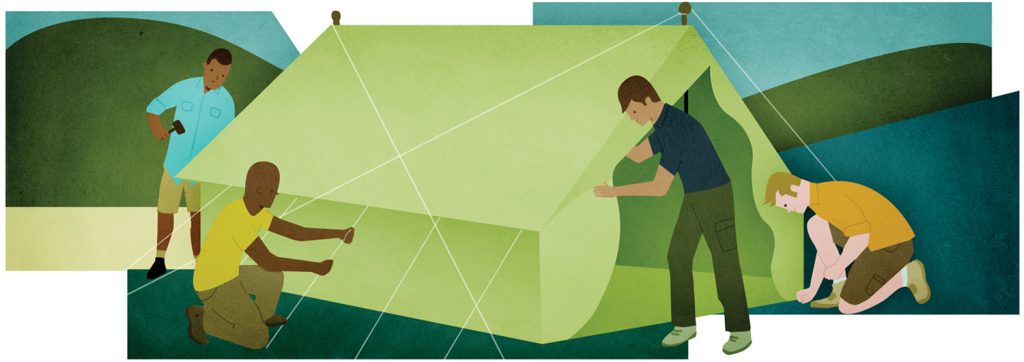
My oldest son hates to do the dishes. It’s that hill he has chosen to die on, persisting in resistance nearly every time he is asked to clean the kitchen. “It’s boring!” he insists, as he reverts to a three year old pouting on the floor. I guess I feel the same way sometimes—clamoring to do the more interesting work, leaving the more meaningless tasks to others. Lord knows how traumatic the tedious can be to our sensitive self-importance.

“After this Paul departed from Athens and went to Corinth. There he found a Jew named Aquila, a native of Pontus, who had recently come from Italy with his wife Priscilla, because Claudius had ordered all the Jews to depart from Rome. Paul approached them, and because he worked at the same trade, he stayed with them and worked with them (for they were tentmakers by trade). He addressed both Jews and Greeks in the synagogue every Sabbath, attempting to persuade them. Now when Silas and Timothy arrived from Macedonia, Paul became wholly absorbed with proclaiming the word, testifying to the Jews that Jesus was the Christ. –Acts 18:1-5

As I read over this passage, the sudden change in Paul once Timothy and Silas arrived struck me. When Paul first arrived in Corinth, he busied himself with tentmaking, not preaching. Except for the Sabbath where he attempted to persuade in the synagogues, Paul spent his time stitching fabric. It is not until his other companions arrived from Macedonia that Paul “became wholly absorbed with proclaiming the Word.”

I’ll be honest, this seems like a misuse of time. Paul was receiving funds from the Philippian church (Phi 4:15; 2Co 11:7-9), so why spend precious time in monotonous manufacturing work, a task that other hands could do just as well.

Some commentators suggest Paul might have been slightly discouraged or depressed, like Elijah in 1 Kings 19:3-6 (see Act 18:9; 1Co 2:3). Considering all the hardships and rejection he had endured, it seems reasonable. Surely the great apostle did not learn to live in contentment (Phi 4:12) without wrestling with it.

Then I ran across a comment by Alexander MacLaren, the great expositor, regarding Paul and his tentmaking:

“Be thankful for your homely, prosaic, secular, daily task. You do not know from how many sickly fancies it saves you, and how many breaches in the continuity of your Christian feeling it may bridge over. It takes you away from thinking about yourselves, and sometimes you cannot think about anything less profitably. So stick to your work; and if ever you feel, as Paul did, ‘cast down,’ be sure that the workshop, the office, the desk, the kitchen will prevent you from being ‘destroyed,’ if you give yourselves to the plain duties which no moods alter, but which can alter a great many moods,” (MacLaren’s Expositions).

This poetic paragraph took me aback (causing me to pause and re-read it several times). Who knows what kind of healing and encouragement took place as Paul fellowshipped with Aquila and Priscilla and worked mindlessly with his hands. It was surely a blessing, a reprieve. Yet, how often do I belittle the simple tasks of life, failing to see the blessed gift of work (Ecc 2:24-25; 3:9-13, 22; Gen 2:15)? How often do I miss the fact that the mundane grants reprieve from challenge and strife?

The walk of the disciple of Christ is a hard road, with many difficult challenges (Mat 24:9; Mar 13:13; Luk 9:23; Phi 1:29; 2Ti 3:12). So if you feel bored in your work, praise the Lord He has given you something simple to do for a season. Take joy in your tentmaking; find contentment in the simplicity of sewing. There is a day on the horizon when you will face lions, bears (1Sa 17:34) and giants (1Sa 17:40-50), but for now enjoy the green pasture and still waters with psalms (Psa 23).

Billy Neal

Share Button
Translate »